The night of July 13, 2025, was supposed to be all about football. Chelsea had made it to the Club World Cup Final, facing Paris Saint-Germain in a historic showdown at MetLife Stadium. The U.S. was hosting this expanded-format tournament for the very first time, and the energy was electric. Celebrities, athletes, politicians, and the who’s who of American and international culture showed up to witness football’s global crescendo under the stadium lights.
But even in a night designed for champions, the spotlight occasionally strays.
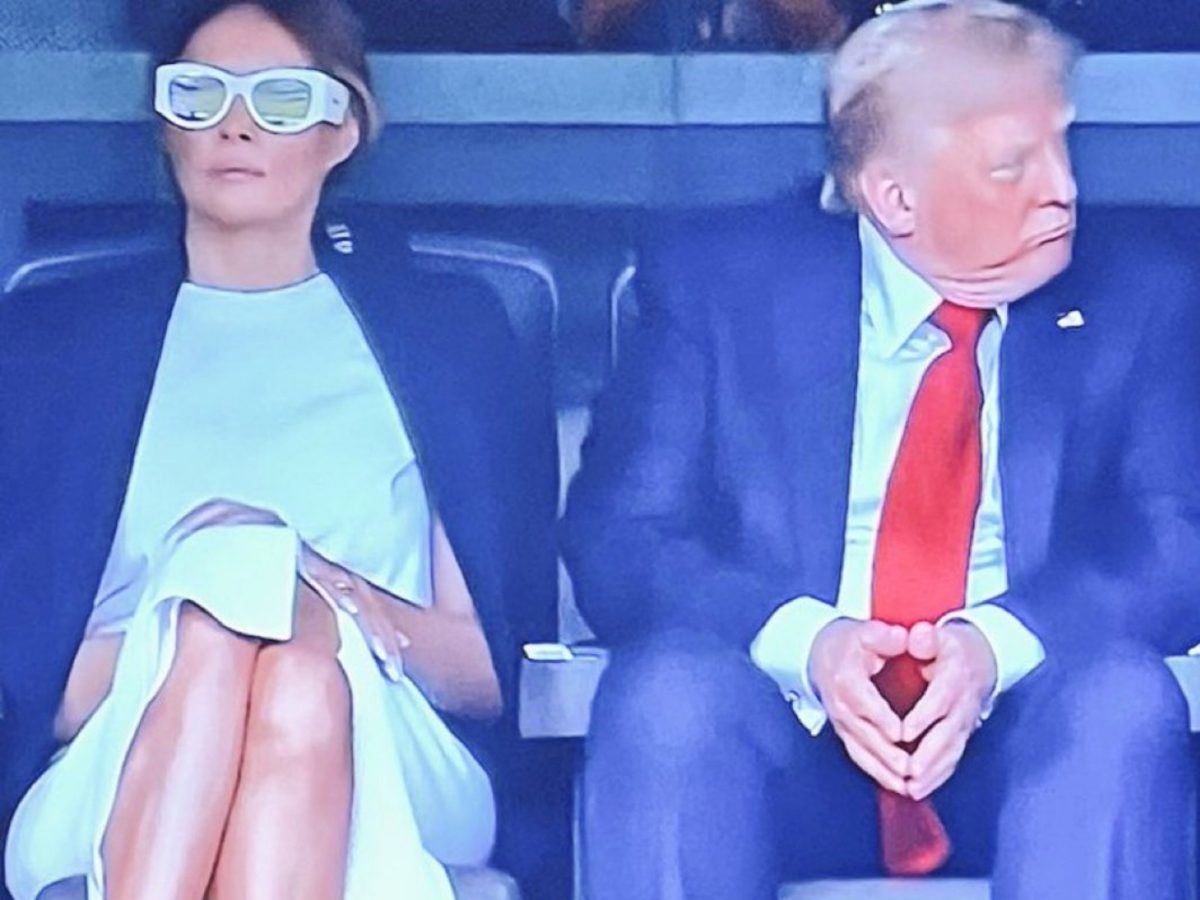
Seated in the VIP section alongside his wife, Melania, President Donald J. Trump made a predictably high-profile appearance. The camera panned to him multiple times during the broadcast, an expected nod to the pageantry of the event. However, amid the glitz and the goals, the internet zeroed in not on Trump’s presence, but on something far more unexpected: his ankles.

In a now-viral frame caught mid-first half, Trump is seen sitting stiffly, his legs slightly forward, socks stretched tight around what appeared to be noticeably swollen ankles. That was all it took. Within minutes, screenshots flooded social media platforms, particularly X (formerly Twitter).
But as the memes reached fever pitch, the online commentary took on a strange mix of comedy, mockery, and, unexpectedly, even defense. The internet can be brutal, yes, but it’s rarely one-dimensional.
One fan mockingly posted,
“The mini Diet Coke next to his grotesquely swollen ankles is very good.”

This was a jab aimed at Trump’s famously poor dietary habits; the visual of a tiny Diet Coke juxtaposed against his visibly enlarged ankles became a symbolic punchline. For this user, the image said it all: a man known for his love of fast food and soda now physically manifesting the consequences courtside at a major football event.
Another fan came in in defense of Trump and said,
“He’s 79. I think it’s ok for his ankles to be a little puffy.”
Here, the tone softened. This user pushed back against the wave of mockery, reminding everyone that Trump is nearly 80 and perhaps swollen ankles shouldn’t be headline-worthy at that age. It was a subtle nudge for the internet to show a touch of empathy, even in the middle of a meme storm.
Another fan again defended by saying,
“He’s just wearing regular dress socks. No one wears ankle compression socks.”
This comment took a more practical stance, essentially arguing that what we were all seeing wasn’t necessarily a health crisis but an unfortunate fashion optics issue. According to this fan, the way regular dress socks fit tightly around the leg can exaggerate swelling, especially when sitting for long periods.
Another fan jokingly said,
“It looks like they put his legs on backwards.”
And then, of course, came the full-throttle comedy. This fan embraced the absurdity of the moment, joking about the unnatural posture and appearance of Trump’s legs in the now-viral photo. It was pure internet exaggeration—ridiculous, funny, and exactly the kind of comment that fuels a trending topic.
So… What’s going on with Trump’s ankles? Let’s break it down.
What’s Going On With Trump’s Ankles?
As it turns out, there’s a real explanation, and no, it’s not that he was hiding shin guards under his trousers. According to a statement released shortly after the game by the White House and reported later by Al Jazeera, the US president has been diagnosed with chronic venous insufficiency, or CVI, a condition more common than most people realize, especially in older adults.
CVI occurs when the small valves in the leg veins, which are meant to keep blood flowing back up toward the heart, become weakened or damaged. When these valves fail, blood can pool in the lower limbs, causing swelling, discomfort, and, in some cases, visible changes in the skin or veins. It’s not life-threatening in itself, but left unmanaged, it can lead to chronic leg fatigue, heaviness, and, as we saw so clearly on match night, swollen ankles.

Doctors close to the Trump camp were quick to confirm that no major complications were involved. There were no signs of deep vein thrombosis, no indications of heart failure, and no circulation-threatening issues. He’s reportedly following a conservative treatment plan, including compression stockings (which may have actually exaggerated the ankle swelling visually), regular elevation of the legs, and a low-dose aspirin regimen to support blood flow.
Scott A. Sundick, MD, a vascular surgeon, described in Fox News that for a man in his late 70s, ankle swelling is “relatively common and benign,” and that the more serious causes were “appropriately ruled out” through diagnostic testing

Dr. Andrea Obi, a vascular surgeon at the University of Michigan, told ABC News that CVI often leads to blood pooling in the legs and even hands due to valve failure and that the typical symptoms (heavy, swollen ankles) appear after prolonged sitting or standing, no surprise under hot and humid stadium conditions,, especially like at MetLife Stadium in the USA, where players have often complained about the weather and how hard it was to play in CWC on these pitches.
In the end, the ankle discourse became yet another reminder of how modern football finals are about more than just the sport. They’re cultural events, woven into the fabric of media, politics, and celebrity. On a night where Cole Palmer was clearly the man of the match, the internet decided to hand the viral MVP to Donald Trump’s ankles.

And while it may seem ridiculous, moments like this speak volumes about the way we consume major sporting events today. The lines between sport, spectacle, and society are blurrier than ever. One minute you’re watching world-class football; the next, you’re Googling medical diagrams of leg veins.
So yes, Chelsea won. Yes, Palmer was electric. But in the grand theater of modern sport, sometimes the most talked-about moment happens nowhere near the ball and everywhere at the ankle.