Pep Guardiola is used to controlling narratives on the pitch, but recently the Manchester City manager has found himself dealing with something far harder to manage — words, ideas, and even moments being created without ever actually happening.
In an era where artificial intelligence is reshaping online conversations, Guardiola admitted he has already started seeing its impact firsthand.
Quotes attributed to him, opinions he never expressed, and narratives built entirely without his involvement have quietly begun circulating across social media.
It is a shift that goes beyond football tactics or results — and one that Guardiola believes could become increasingly difficult to control.
That concern did not feel abstract for long.
Pep Guardiola’s AI Warning Explained by Viral Barcelona Video
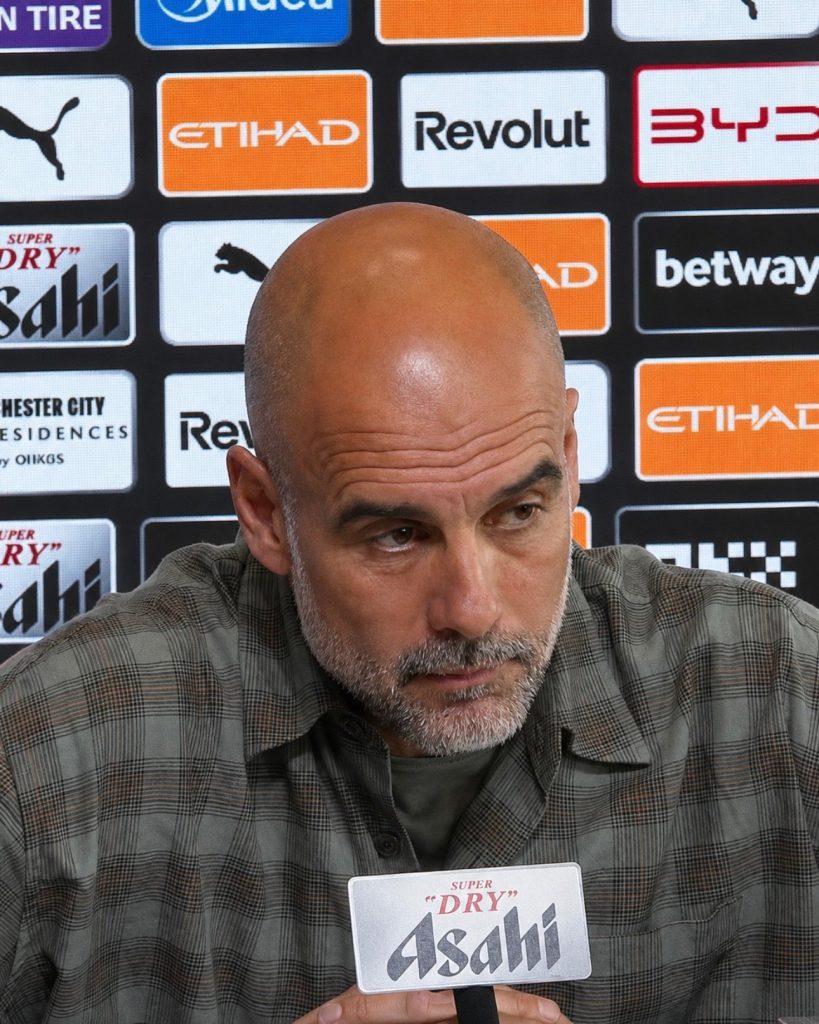
Speaking during an embargoed pre-match press conference ahead of Manchester City’s clash with Crystal Palace, Pep Guardiola addressed the issue directly.
Pep Guardiola says AI is ‘DANGEROUS’ after La Liga use him in AI slop video with Messi! 😬🤖
— City Report (@cityreport_) May 12, 2026
🎥 @BeanymanSports pic.twitter.com/6Gd0g0l1hr
Guardiola said: “In the world, many, many other disaster things I think about. But I saw on ChatGPT or the other ones, some statements and comments — and on Twitter — that I’d never done.
I remember a month ago, ‘Pep chose the best 11 of his career.’ I’d never done that, I never did, and never would. I have more respect for all the players I had.
But ‘Pep said that’ and people said, ‘Oh, Pep, he chose this player than the others!’
That is dangerous — fake news and incredible things that have not happened.
ChatGPT, if you have to make an exam or something, you go there, they do it for you. You don’t have to work [in the mind]. I don’t know what’s going to happen in the future.”
He added: “My children are adults… but in social media today, they can put your face there and say ‘I did this interview’ — when I didn’t. It is what it is.”
At first glance, it sounded like a general warning about misinformation. But just yesterday, a viral post from LaLiga provided a striking real-world example of exactly what Guardiola was cautioning against.
Un título que habla sobre la historia del @FCBarcelona_es. ✨ #DesenlaceLALIGA | #IA pic.twitter.com/8lYE4ru2WW
— LALIGA (@LaLiga) May 11, 2026
The AI-generated video shows a sequence of Barcelona legends appearing one after another — Johan Cruyff, Diego Maradona, Rivaldo, Ronaldinho, Andrés Iniesta and Lionel Messi — each represented in their respective eras.
Lamine Yamal is then shown interacting with each of them in chronological order, before the sequence shifts to Pep Guardiola standing between Messi and Iniesta for a posed frame.
The video concludes with Yamal turning the camera toward himself and tapping his chest, symbolically positioning himself as the next chapter in that legacy.
The moment then shifts to Guardiola positioned between Messi and Iniesta, before the young winger turns the camera toward himself — connecting the club’s past directly to its present.
The intention was clear: a visual tribute to Barcelona’s history.
But the reaction it triggered highlighted something deeper.
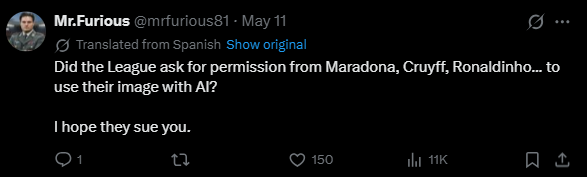
Fan reactions were divided. Some described the video as “cold” and appreciated the concept of connecting generations, while others questioned whether it was appropriate to digitally recreate legendary players.
A section of fans also raised concerns around consent and authenticity, pointing out that such AI recreations could distort real legacies or create narratives that never truly existed.
For many, the discomfort was not about the tribute itself, but about how easily AI can reshape real legacies into constructed narratives.
And that is precisely where Guardiola’s comments take on greater importance.
Because his concern is not just about incorrect quotes — it is about control.
Guardiola operates at the highest level of modern football, managing one of the most tactically demanding teams in Europe.
Even this season, Manchester City have had to constantly adapt — adjusting their midfield balance, dealing with injuries, and evolving their approach across competitions.
Yet alongside those footballing challenges, Guardiola is now also addressing a different kind of disruption: the reliability of information itself.
When a manager of his stature begins questioning whether statements, images, or narratives can be trusted, it signals a broader shift in how football is experienced beyond the pitch.
Artificial intelligence is no longer limited to data analysis or performance metrics.
It is now influencing storytelling — recreating moments, reshaping history, and generating content that can blur the line between reality and fabrication.
The LaLiga video may have been intended as a tribute.
But combined with Guardiola’s warning, it represents something larger — a sport beginning to navigate a space where its past can be recreated, its present reinterpreted, and its future shaped by technology that does not always require truth to exist.
Guardiola himself acknowledged that uncertainty.
“I don’t know what’s going to happen in the future,” he said.
For football, that uncertainty is no longer theoretical.
Read More : Ex Man City Star Stephen Ireland Suffers Horror Double Leg Break In Sunday League Match