Giorgi Mamardashvili burst into the popular football conscience last season after a spree of starts for Liverpool. The Georgian came under immense scrutiny while serving as a backup for long-time number one Alisson Becker at Anfield.
Mamardashvili made 10 starts for Liverpool in the Premier League, rotating with the Brazilian who was managing work to keep fresh for the 2026 World Cup. His displays left a lot to be desired during the time, casting doubt at his status as the Reds’ eventual replacement for their veteran star.
The same trend continued in Liverpool’s recent pre-season where Mamardashvili was again used sparingly alongside Alisson. He played five times across their various tours, including two full games against Como and Leeds United, conceding four goals in the latter fixture.
If the performances were not disastrous enough, Mamardashvili has hurt his chances even more with off-field antics. The Georgian has come under heavy flak after recent potentially racist Instagram stories of his went viral.
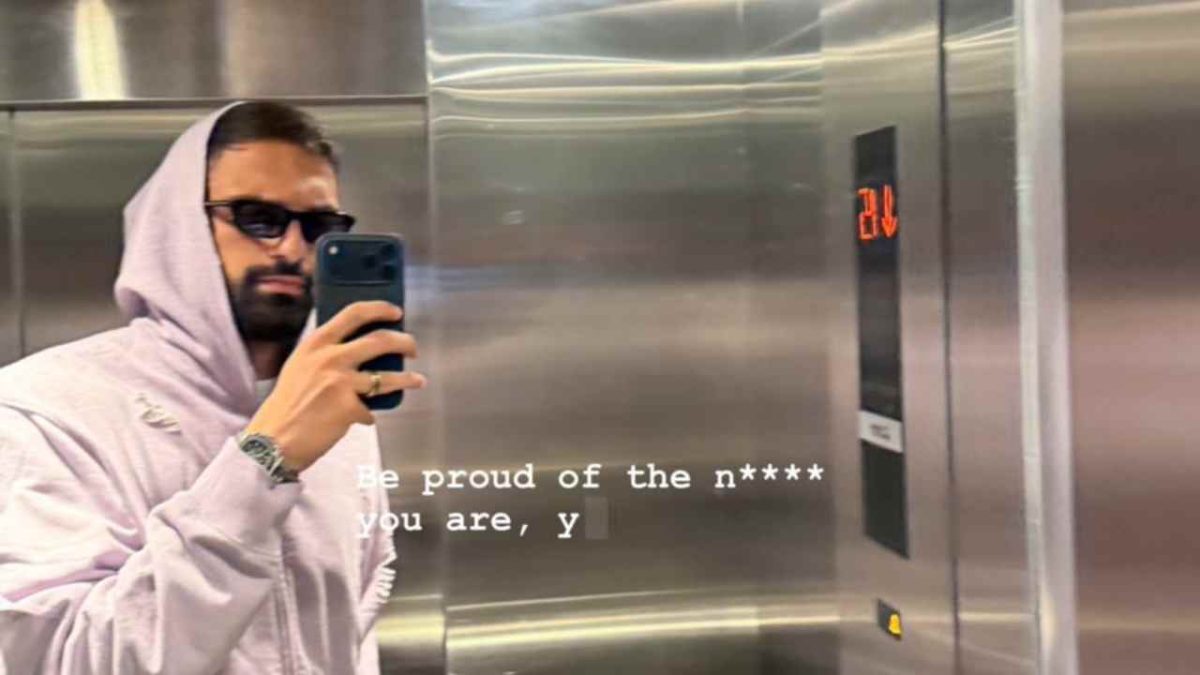
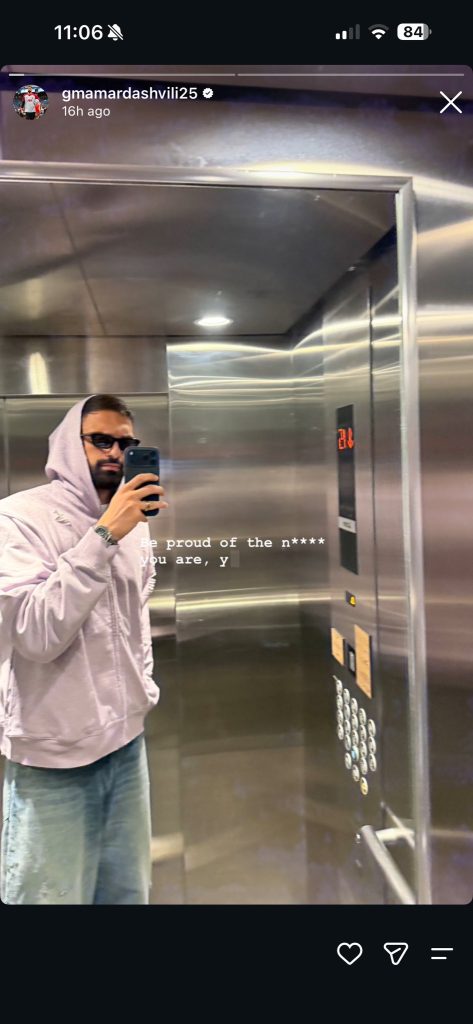
The first of those featured an innocous mirror selfie of Mamardashvili travelling in a lift. The Georgian was clad in a lavender hoodie and denim jeans with black sunglasses covering his eyes.
That was not the problematic part. The controversy arose because of the song he chose to add to the post.
The track in question was the 2025 hit Man in the Mirror released by New York rapper Dave East as part of his Karma 4 album’s deluxe edition, featuring Californian artist Big Sean.
Even though the jam did not enjoy much chart success, it was well received in the hip-hop circles because of the heavy lyrical content. Both Dave and Sean adopt a retrospective tone on the track to reflect some light on themselves and their surroundings, talking about various vices such as money, partying, and chasing women.
However, like pretty much any rap song out there, the n-word was used recurrently on the track. In fact, the very intro of the song goes, “You know, being a man, you gotta learn how to provide; Be proud of the n**** you are, you know?”
Now, adding rap songs carrying the n-word is no new phenomenon amongst footballers and celebrity at large. But Mamardashvili went out of his way to embroil himself in controversy.
The Georgian made the conscious choice of using the showcase lyrics feature on Instagram, thus proudly displaying the taboo word loud and center in the story.
Fans were quick to point out that in the advanced era of internet, sensitivity surrounding the n-word is ubiquitous. Use of it by non-black individuals is a blatant trigger to get cancelled online, yet it did not stop Mamardashvili from posting a story on his public account with 846K followers at present.
Little did they know it was about to get much worse.
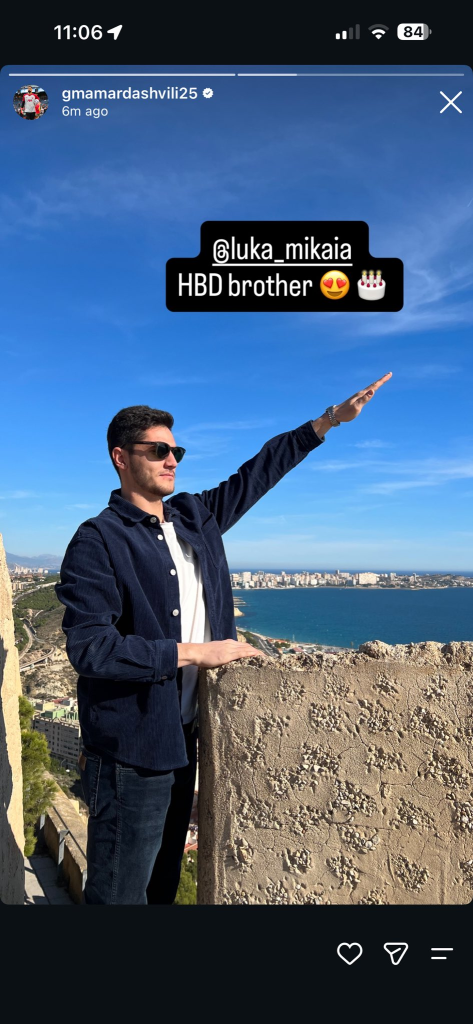
A mere 16 hours later, Mamardashvili posted another story wishing fellow Georgian goalkeeper Luka Mikaia a happy birthday. The 25-year-old is listed as last playing professional football for Kolkheti Khobi in 2023/24 before being let go of his contract.
The photograph shows him standing atop a platform overlooking the coastline. Mikaia has his sunglasses on and is peering at the horizon off-screen with his arm-raised, seemingly pointing at the distant expanse.
But it is not so simple. Not only is Mikaia’s stiff arm extended fully in an extended position, but his palm is also open facing downwards. It does not take a rocket scientist to figure out the similarities between the gesture and a Nazi salute.
The raised arm has been the most symbolic way of referring to Adolf Hitler for nearly a century now. When the genocidal premier of Germany was still in power in the 1930s and 40s, the gesture was popularly used by his countrymen to hail him as their leader.
Consequently, it is understood to be a remark made to disparage jews who were the primary victim of Hitler’s atrocities.
Mamardashvili’s stories come at a time when racism is one of the most discussed subjects in football. While the issue has infested the beautiful game for as long as one can remember, increasing awareness through social media has led to an active assault on such thought patterns.
The two major governing bodies of the sport, UEFA and FIFA, have numerous wide-reaching initiatives to phase racism about football. In fact, UEFA’s “Say no to racism” campaign has been its most widely pursued for over a decade now.
Only last year, a major controversy saw Real Madrid’s Vinicius Junior allege he was racially abused by Benfica’s Gianluca Prestianni for racist remarks. Even though the investigation that ensued concluded Prestianni’s comments uttered under hand covering his mouth were racist and not homophobic, he received a six-match ban all the same.
The incident also forced FIFA to introduce an unprecedented rule for the World Cup in the summer. Any player seen talking to rivals in a controversial manner or situation received direct red cards, victims of which included Paraguay’s Miguel Almiron and Ecuador’s Pierro Hincapie.
The saying goes once is happenstance and twice is coincidence. But when successive incidents occur in such a little window of time, scrutiny is only inevitable.
Only Mamardashvili can know whether he intended to imply racist messages with his two stories. One thing is for sure though, he won’t live down either incident any time soon.
For the moment, he is likely to sit on the bench when Liverpool begin the new season at Newcastle on Sunday.