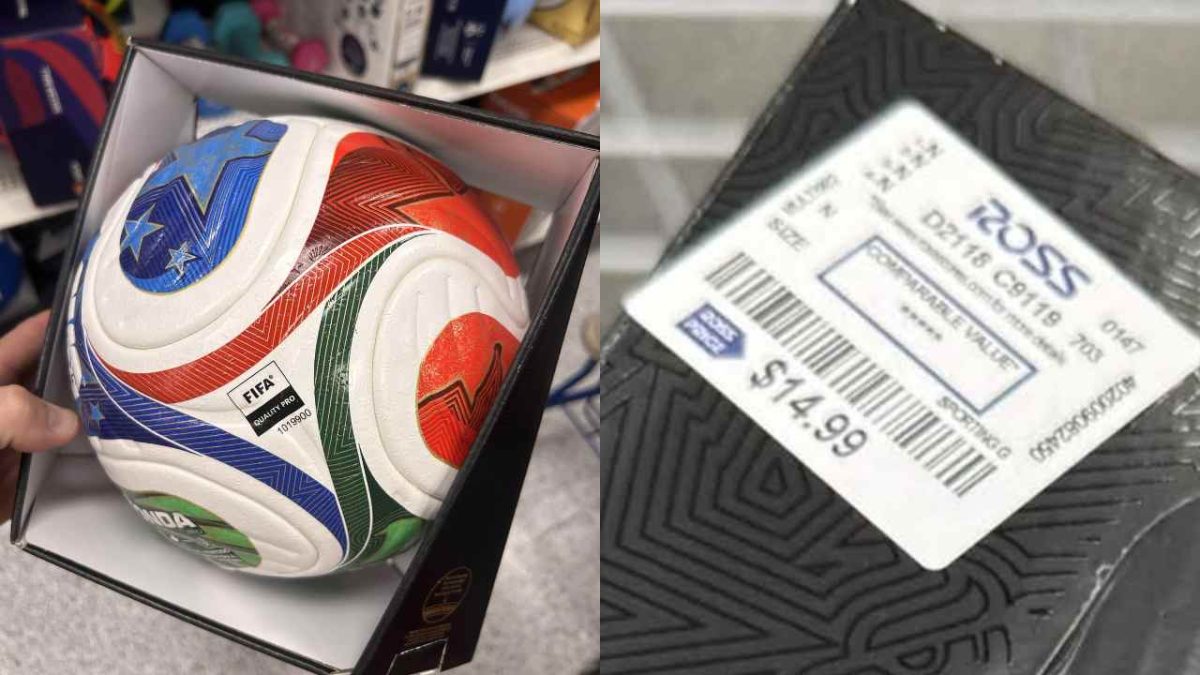
Global sportswear giant Adidas is once again in the news. However, this time it is making the headlines over the huge discount on its Trionda ball. Trionda [Spanish word for three waves] is the official football that was used in the matches for the 2026 FIFA World Cup, jointly hosted by the United States, Canada, and Mexico.
However, the prices of the Trionda ball have been lowered by more than 80 percent, with some balls available for as cheap as $14.99! Yes, you read that right: the very Trionda ball that was launched in October 2025 with an initial price of $170 is now available for less than 1/10th of its price.
As per Footy Headlines, it has been spotted at off-price retailers like Ross Dress for Less in the U.S. for around $14.99—a discount of over 90% a few months after the World Cup wrapped up. Photos of the Trionda were shared all over social media, showing a boxed Trionda Pro [with the $14.99 Ross price tag], which was purchased by a collector in Florida for $16 [inclusive of all taxes].
Likewise, similar photos also surfaced on Reddit, confirming that there is surplus stock of these footballs that are yet to be cleared off, and have subsequently made their way to the US off-price retail markets alongside the lower-tier replica models.
But why did the owners choose to reduce the price of the World Cup ball? The simple reason for this change is that the World Cup tournament is over. Now there continues to be stock that hasn’t been sold yet, so the retailers have to clear it out by hook or by crook. Once the World Cup concluded in July, the demand cooled down, and excess stock was shifted to discount and off-price channels.
The very ball that was once available for nothing less than $150 is now being sold for as low as $15 or $16. Apart from that, the lower-tier editions carry lower base prices than the Pro match ball, and there are also counterfeit versions that are almost identical to the original smart ball.
The Trionda Ball wasn’t any random ball associated with the FIFA World Cup, it was an AI powered Smart ball as well. The ball was capable of collecting loads of data about each game. It contained a special sensor [which was a significant improvement from the designs of the 2022 edition]. As it moved around the football pitch, the Trionda gathered data from the sensors placed around the stadium, and those sensors were connected to the one inside the ball. It could track data at a super-fast rate of 500 times a second, which means referees will be able to make better decisions about things like offside goals.
A significant example of this was witnessed in a 2026 World Cup game between Sweden and Tunisia. A goal by substitute Mattias Svanberg, that was initially dismissed as offside was allowed after the data from the connected ball revealed that a slight touch from another Swedish player had actually played the goal scorer on, making the goal valid. This wasn’t the case with the Al Rihla [the official ball for the 2022 World Cup]. The Trionda Ball will be an inspiration to future designers for the subsequent editions.