The UEFA Champions League returns to London this season, but under incredibly surreal circumstances. When the tournament kicks off, Stamford Bridge will be completely decked out to host home matches, but not for Chelsea. Because the London club finished tenth in the Premier League last season and completely missed out on European football, their iconic stadium was left wide open to host Shakhtar Donetsk.
Seeing a massive global powerhouse host another club’s home stadium environment is incredibly strange, but the two clubs actually share a deep friendship. Their strong bond dates back to the massive transfer of Mykhailo Mudryk and their collaboration hosting the Game4Ukraine charity match at Stamford Bridge. Yet, beneath the heartwarming gesture of Chelsea rolling out the blue carpet, there is a deeply heartbreaking reality behind why Shakhtar must play their home games thousands of miles away from Ukraine.
The humanitarian hub seized by war
The heartbreak for Shakhtar began when armed conflict erupted across the Donbas region. Built at a massive cost of over three hundred million pounds, the Donbas Arena sits right in the heart of Donetsk. Before the conflict escalated and forced the club out permanently, the ultra modern stadium was actually converted into a lifeline for the local people.
The Rinat Akhmetov Foundation transformed the arena into a massive humanitarian warehouse, distributing over eleven million food packages to civilians caught in the crossfire. However, in early 2017, armed separatists seized complete control of the stadium, totally paralyzing the relief efforts and locking the football club out of their home for good. With their home territory occupied, the club had no choice but to permanently flee for safety.
A fortress for historic European nights
The fall from grace is genuinely hard to stomach when you remember the legendary nights the stadium used to host. When the arena opened, it quickly became an absolute fortress in European football. Massive clubs like Arsenal, Barcelona, and Borussia Dortmund all experienced the terrifying atmosphere generated by the local supporters.
Ironically, Chelsea knows exactly how intimidating the stadium was. Back in October 2012, the London club traveled to the Donbas Arena for a crucial Champions League group stage match and suffered a famous two one defeat. Former stars Alex Teixeira and Fernandinho completely tore through the English defense under the bright floodlights that night.

How does Donbas Arena look like now?
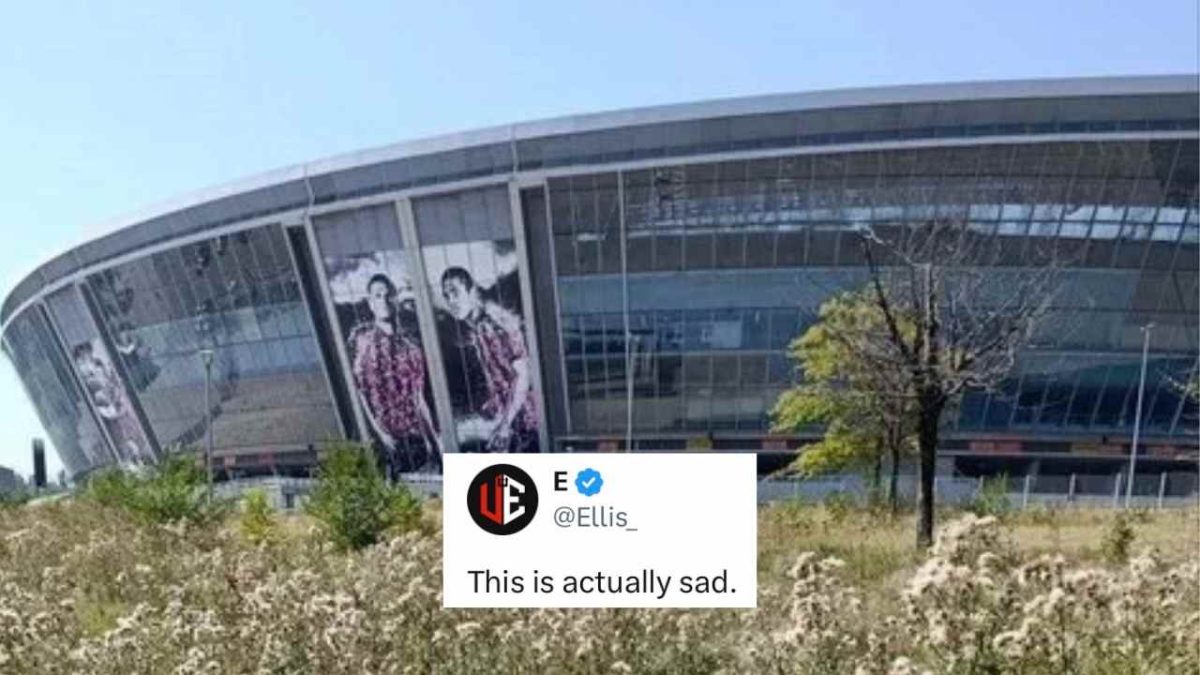
Today, the stadium looks like a scene from an apocalyptic movie. Four new photos shared by local sources on X recently revealed the absolute devastation of the occupied arena.
As Shakhtar gears up for its UCL League phase campaign at Stamford Bridge, here’s the current state of its once state of the art Donbas Arena in russian occupied Donetsk
— Zorya Londonsk (@ZoryaLondonsk) August 25, 2026
12 years have passed since Shakhtar last played at their real home
📸: Butusov Plyus (TG) pic.twitter.com/az3ZgsYmNV
The first image shows the once glorious exterior completely shattered, with massive blast holes and broken glass panels exposing the rusted skeleton of the building. The second photo captures the abandoned metal turnstiles, standing completely empty where fifty two thousand fans once gathered. The third picture is perhaps the most surreal, showing towering wild weeds and thick reeds entirely swallowing the wide concrete walkways. Most chilling of all, the fourth photo reveals danger signs posted directly on the perimeter fences, warning local residents about unexploded landmines buried in the surrounding grass.
Донецк. Заброшенная и запущенная «Донбасс Арена» стоит с выбитыми стеклами и зарастает бурьяном.
— Денис Казанський (@den_kazansky) August 25, 2026
Когда-то это был один из лучших стадионов Европы. Ну а теперь – «русский мир»… pic.twitter.com/78QNwkXxog
Looking at these images brings a deep sense of grief for anyone who loves football. Stadiums are supposed to be sacred places where a community finds its voice. Shakhtar have shown incredible spirit over the years, playing their home matches in exile across Lviv, Warsaw, Hamburg, and now London. But no matter how many trophies they lift on their travels, the decaying shell of the Donbas Arena stands as a silent casualty of war, and a heartbreaking ghost of a golden age that may never return.