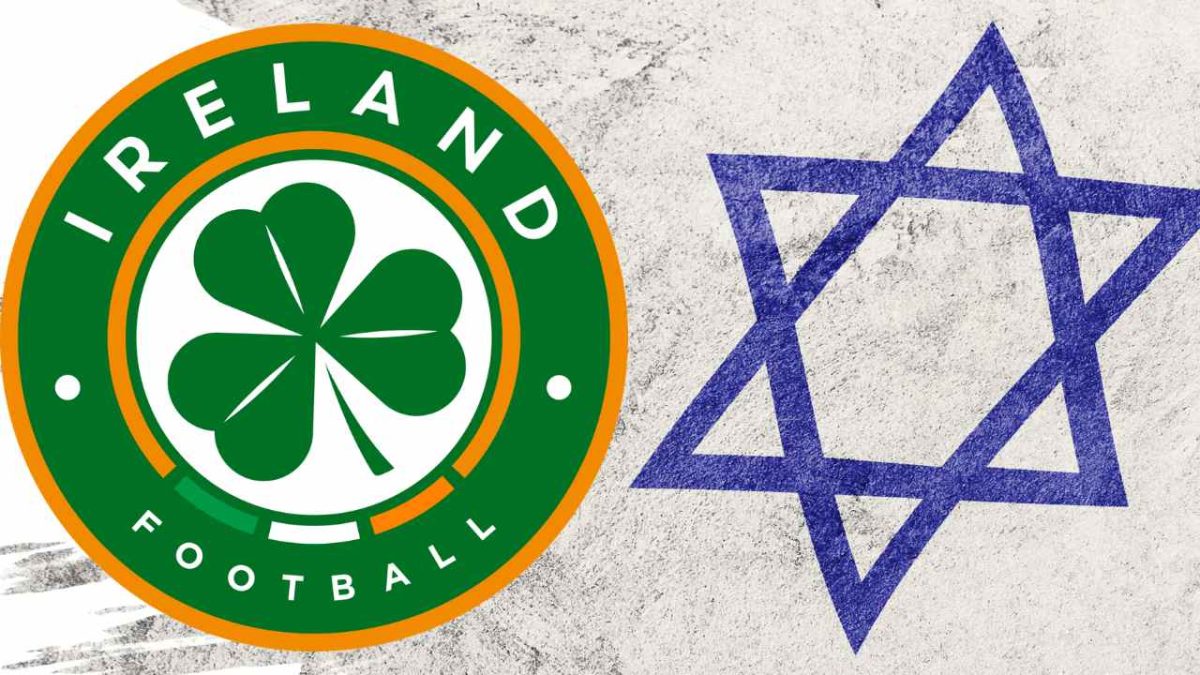
The intense geopolitical and sporting dispute between Israel and the Republic of Ireland has officially escalated into an unprecedented international controversy, just days before their UEFA Nations League doubleheader.
The tension escalated after remarks from Ireland’s national team manager, Heimir Hallgrimsson, spoke against Israel.
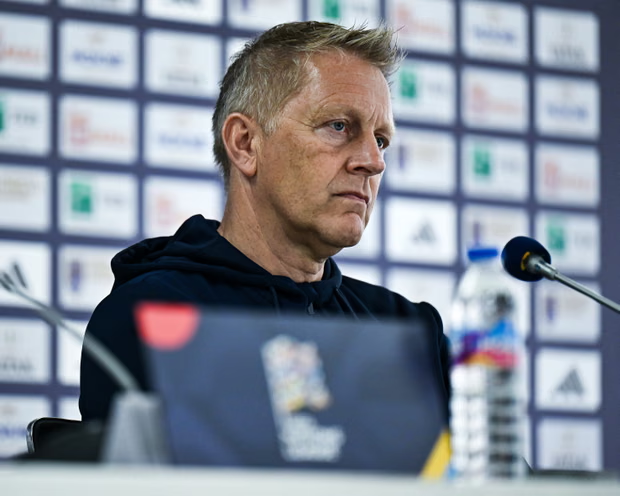
In a press conference on September 17, 2026, Hallgrímsson announced his official 26-man squad and addressed player concerns by revealing that he held individual discussions rather than group talks to avoid peer pressure.
“To all of them individually uh on that because you shouldn’t be doing this on a on a group talk. Uh, and obviously we have different opinions, you know, different strength of opinion. And I can just say, I think it’s best to say without going into individual. Uh, none of us feel comfortable playing these games.
“But once they’re we’ve decided to play them, we all stick together and and and play as one, and we want to represent Ireland with the best games and performances that that we can. So that’s just,you know, that’s the agreement between all of us. But obviously, we don’t have we all share the same opinion, uh, and that’s just human nature.”
He admitted that none of us are comfortable playing these games, but stated that because the Football Association of Ireland has decided to complete the fixtures, the squad will stick together and play as one.
However, the situation became heated when the coach stated that Ireland was playing against genocide because of Israel’s ongoing military campaign in Gaza.
We’re not playing with genocide, we’re playing against genocide. We’re playing against Israel, we’re not playing with Israel
But hearing these words, the Israel Football Association fired back at Hallgrimson with a highly critical statement on X.
We have contributed to the world and humanity in countless fields, earning an impressive number of Nobel Prizes along the way. Unfortunately, we have not yet found a cure for stupidity, ignorance and hypocrisy displayed by @IrelandFootball team coach. We’re not playing with…
— ISRAEL FA (@ISRAELFA) September 21, 2026
The IFA stated that they have made significant contributions to humanity in a variety of fields, earning numerous Nobel Prizes, but have yet to find a cure for the Irish coach’s stupidity, ignorance, and hypocrisy. They concluded that they were up against the coach who exemplified those characteristics.
Ireland’s football manager called a match against Israel a match against genocide.
— Yossi BenYakar (@YossiBenYakar) September 21, 2026
Heimir Hallgrimsson said, we are not playing with genocide, we are playing against genocide. Ireland refused to host Israel. The Nations League games were moved to neutral grounds.
That is not a… pic.twitter.com/LpN5AZVWc2
This official response sparked widespread online outrage, transforming social media into a digital battleground. Israeli fans described the manager’s rhetoric as an antisemitic event that necessitated an immediate response from UEFA, claiming it labeled the entire Israeli squad as a genocidal team prior to kickoff.
Irish supporters, on the other hand, mocked the IFA by posting side-by-side images of Israel’s current crest, which closely resembles a recolored version of Ireland’s former national team badge.
Israel copying Ireland’s old crest. It’s not like them to steal something that isn’t theirs! https://t.co/5nBFnHv0E1 pic.twitter.com/5sxiIvl8LJ
— 🔻Bráman ૐ 🇵🇸🇰🇵 (@edgesurfer_) September 21, 2026
The political fallout quickly spread to the state level when Irish Prime Minister Micheal Martin intervened, calling the IFA’s remarks unacceptable.
Martin told reporters in New York, where he is attending the UN general assembly.
I think those are unacceptable remarks; they should be withdrawn. Israel can’t keep denying what the world knows, and what the world understands.
Meanwhile, former international star Kevin Kilbane wrote a scathing op-ed in The Irish Times, claiming that Ireland should not have played Israel anywhere and that the Irish public would have gladly faced any financial consequences or UEFA sanctions together.
Ireland should not be playing Israel. Not in Dublin, not in Hungary, and definitely not a ‘home’ match in Serbia. Not while Israeli forces are committing genocide. We as Irish people – could have faced down the consequences together.
The FAI had previously petitioned UEFA to suspend Israel or separate the nations, but UEFA turned down the request, threatening severe financial penalties and a possible ban from co-hosting Euro 2028 if Ireland boycotted. As a result, the matches will be held on neutral grounds with strict security measures in place.
Israel’s home match on September 27 will be held in Debrecen, Hungary, while Ireland’s home match on October 4 will be in Backa Topola, Serbia. No fans will be allowed, and Irish public broadcaster RTE will broadcast a stripped-down feed with no commentators, pundits, or advertising revenue.
According to Israeli media reports, their squad will skip post-match handshakes and shirt swaps in order to avoid provocations.
One of the teams Ireland will be facing this international break is… Israel 👀 https://t.co/Hp1OORNY82
— Leyla Hamed (@leylahamed) September 21, 2026
The toxic atmosphere has even spread to unrelated sporting contexts; when Spanish club Real Betis posted a supportive message for their new Irish striker, Troy Parrott, journalist Leyla Hamed and activist groups quickly re-contextualized the post to highlight the contentious upcoming fixtures, demonstrating how deeply this crisis has permeated global professional football culture today.
Ireland’s upcoming Nations League matches against Israel have sparked a massice #StopTheGame protest movement, which includes football fans, activists, athletes, and local clubs.
Ireland fans continue to show support for Palestine ahead of controversial Israel fixtures. pic.twitter.com/6Rqmp2FAju
— VERSUS (@vsrsus) September 23, 2026
Large banners reading “Genocide is Not a Game,” “Don’t Play Ball With Genocide,” and #STOPTHEGAME have appeared at League of Ireland matches, and protesters have gathered outside the Republic of Ireland team hotel, waving Palestinian flags and urging players not to participate.
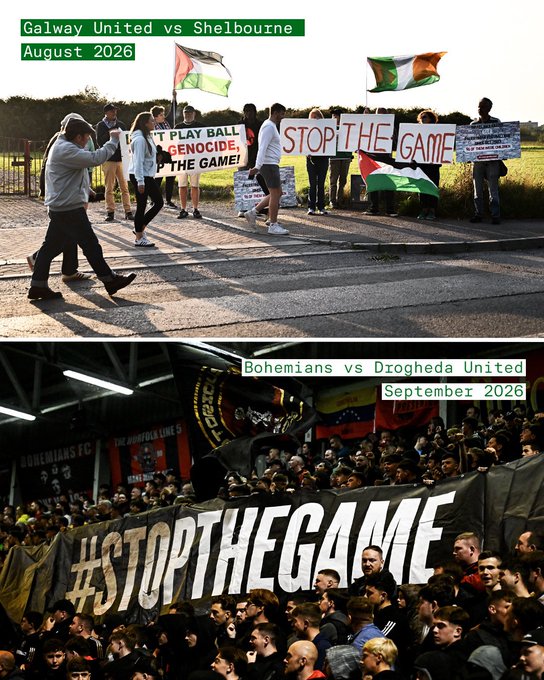
More than 160 Irish sportspeople have signed an open letter urging the Football Association of Ireland to boycott the matches. The FAI had asked UEFA to suspend Israel from international competition, but the matches are set to take place at neutral venues in Hungary and Serbia.
"Before Israel closed its embassy in Dublin last year, Israeli diplomats would quietly tell you that they regarded Ireland as the worst diplomatic posting in Europe." (From my article in @WSJFreeEx today). https://t.co/3USzgrnODH
— David Quinn (@DavQuinn) September 23, 2026
The protests reflect Ireland’s broader political support for Palestine, which is influenced by the country’s own history of British rule, partition, and conflict.
Irish activists frequently draw parallels between Palestinian displacement and Ireland’s colonial history, while the legacy of the Troubles has influenced comparisons of military checkpoints, internment, and movement restrictions.
Ireland formally recognized the State of Palestine in May 2024, alongside Spain and Norway, and later supported South Africa’s case against Israel before the International Court of Justice. Israel has announced that its embassy in Dublin will close in December 2024, citing Ireland’s policies toward Israel.
As a result, football matches have become yet another forum for Ireland’s long-running political and historical debate.