The 2026 World Cup is almost here, and England are heading into it with one of the most talented squads in the tournament.
For England, this tournament is not just another chance. It is another test of whether they can finally end one of football’s longest waits.
They have not won a major men’s trophy since the 1966 World Cup.
Since then, England have had great players, famous managers, deep tournament runs and endless hype.
But every generation has been left with the same question hanging over it: why does a country with so much talent keep falling short?
The most painful example remains the Golden Generation.
In the 2000s, England had David Beckham, Steven Gerrard, Frank Lampard, Wayne Rooney, Rio Ferdinand, John Terry, Ashley Cole, Michael Owen and Paul Scholes.
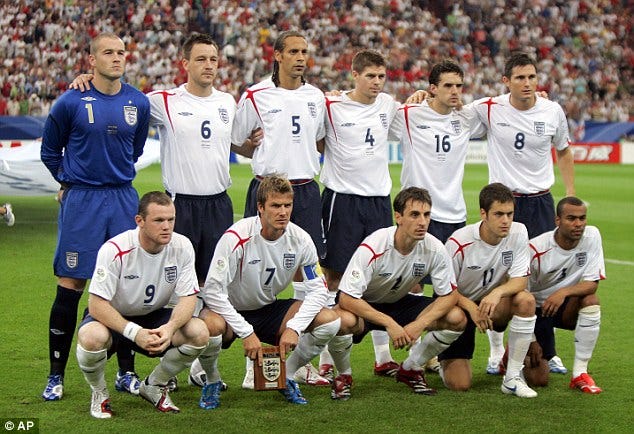
That was not just a strong squad. It was a team packed with Premier League icons and Champions League-level players.
On paper, England should have been competing for World Cups and European Championships.
Instead, that group never reached a major final.
There were plenty of reasons; tactics were questioned, managers struggled to find balance, and penalty shootouts became trauma.
But one explanation has followed that era more than most: the club rivalries inside the squad.
England’s biggest players spent the season fighting each other; Manchester United hated Liverpool, Chelsea were battling Arsenal, United and Chelsea were chasing the same titles, Liverpool and Chelsea had their own European wars.
These were not small rivalries; they shaped the Premier League.
Then, suddenly, those same players were expected to become brothers for England.
Stories from that era have often pointed to club cliques inside the national team.
Players naturally stayed close to the teammates they knew and rivalries from club football made real unity harder to build.
England had talent everywhere, but talent alone was never enough.
This trend looks to have followed England in what could be their next golden generation.
Recent reports from the Telegraph have claimed there is tension between Jude Bellingham and Declan Rice inside the England setup.
Jason Burt of the Telegraph suggests that Declan Rice’s fierce competitive spirit led to a clash with Jude Bellingham, with both players regarding themselves as the dominant figure and the future captain.
Declan Rice has a fierce competitive spirit which has led to him clashing with Jude Bellingham in the England set-up. They regard themselves as the dominant figure and successor to Harry Kane as captain & there has been tension between the pair in the past. ❌😤 [@JBurtTelegraph] pic.twitter.com/TiKN0HHtTe
— DailyAFC (@DailyAFC) May 27, 2026
That alone is enough to raise eyebrows, because these are not fringe players. They are two of the names England is expected to build around at the 2026 World Cup.
However, as the reports reveal, this is not the first time talk of tension between them has come up.
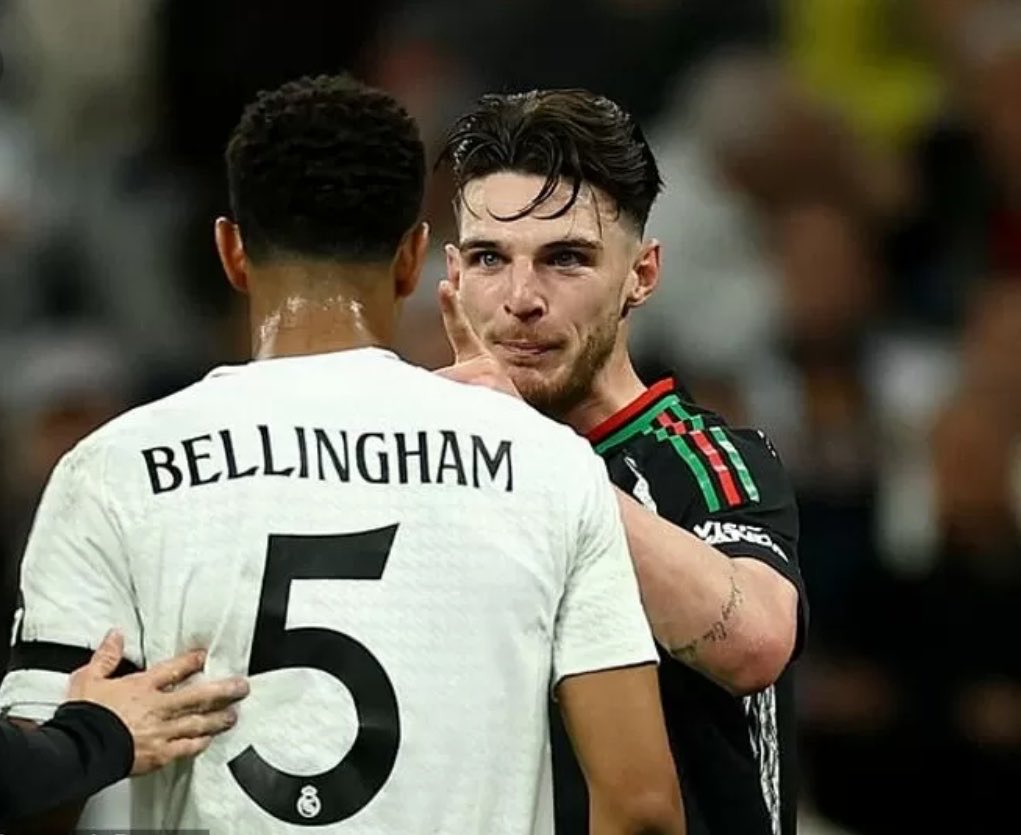
Last season, during Arsenal’s Champions League Quarter-Final clash with Real Madrid, Rice and Bellingham were on opposite sides of a huge European night.
Rice was fighting for Arsenal, Bellingham for Madrid, and the match had all the pressure and emotion of a knockout tie.
At the time, clips surfaced of the two midfielders appearing to clash during tackles and exchanging confrontational looks.
— kay (@kkpclear) May 27, 2026
Back then, it could easily be dismissed as normal Champions League heat: two elite competitors, two massive clubs, one intense match.
But now, with fresh reports suggesting tension inside the England camp, those old clips are being viewed differently.
What once looked like a one-off flashpoint is thought to be the starting point of this apparent feud between the two stars.
A post-match video of them hugging was also shared, although some fans believed that the two Englishmen did not exchange the friendly words you would see with any other England players after a match.
Declan Rice’s reputation is built on leadership, emotional control and a relentless team-first mentality.
He is seen as Arsenal’s “vibe controller,” a popular dressing-room figure, but also a fierce competitor who has grown into one of the club’s key leaders.
He has worked hard to control his body language, stay composed under pressure and channel his emotions into leadership rather than frustration.
Bellingham brings a different kind of energy. His quality is not in question, but his intensity has often become part of the conversation around him.
From his dad storming the Dortmund dressing room, to Jude causing unrest in Ancelotti and Xabi Alonso dressing rooms, to his reported feud with Mbappe.
Thomas Tuchel has also spoken about the need for Bellingham to direct that fire toward opponents rather than teammates or referees.
The contrast in their personalities makes it harder for England to keep the dressing room and midfield balanced, with Rice’s vocal leadership and Bellingham’s fiery edge both demanding their own respect and space in the same team.
Bellingham and Rice are not just two players caught in a social media storm, they are central to England’s entire project.
Bellingham brings star power, confidence and the ability to decide games on his own, while Rice brings control, leadership and defensive balance.
Together, they should give England the kind of midfield base most countries would love to have.
That is why even the suggestion of a rift feels dangerous.
England has already lived through an era where elite club players could not fully become an elite international team.
The Golden Generation had names, status and experience, but the unity never matched the talent.
These reports bring that uncertainty and doubt over the current generation as well.
Footballers clash in big matches all the time, and social media has a habit of turning body language into breaking news. A stare, a gesture or a heated exchange does not automatically mean two players cannot share a dressing room.
But with these reports coming out, England cannot afford to be careless with this.
The 2026 World Cup is too big, and this squad is too talented, for old mistakes to return in a new form.
Bellingham and Rice may simply be two elite competitors whose club battle has been reinterpreted because of a fresh rumour.
But if the tension is real, England has seen this warning sign before, and this time, they cannot afford to ignore it.